



Orthopedic Procedures
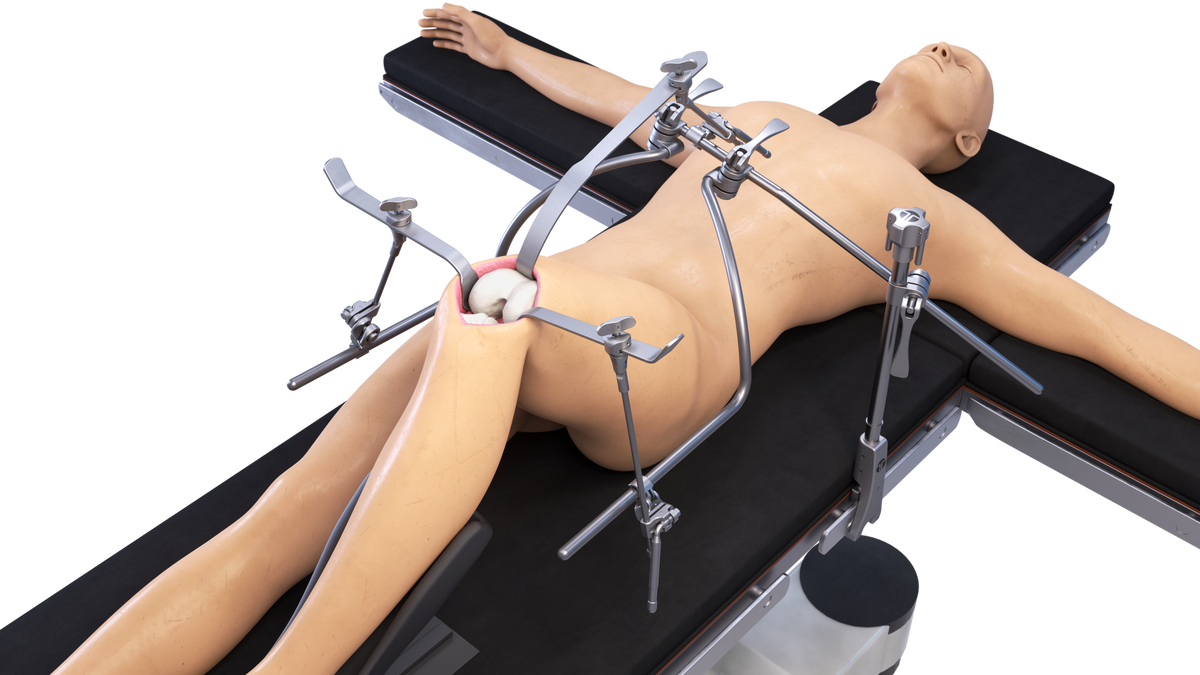
Table-Mounted Retractor Sets for Orthopedic Procedures
Thompson orthopedic retractor sets use a distinct approach to exposure. The Hip Retractor Set may be used for hip, knee, and shoulder applications, with the table-mounted frame arranged differently for each joint. The Femur Elevator Retractor Set is a separate, focused configuration for controlled femoral elevation and may be used alone or purchased with the Hip Retractor Set as an add-on.
For hip procedures, the shared frame is paired with Thompson hip blades to achieve femoral neck, acetabular, and proximal femoral exposures. For knee and shoulder procedures, the same table-mounted frame supports compatible surgeon-selected retractors. This shared architecture provides surgical teams with a stable foundation for hands-free retraction while allowing setup, blade selection, and attachment methods to match the procedure.
Why Orthopedic Procedures Require Stable, Controlled Retraction
Orthopedic exposure changes throughout a procedure. Hip, knee, and shoulder cases each require controlled access around the joint while preserving space for reamers, broaches, saws, trial implants, imaging, and other instrumentation.
Effective orthopedic retraction should support:
- Stable positioning of multiple retraction points
- Controlled adjustment as exposure needs change
- Working space for implant preparation and instrumentation
- Compatibility with the OR table, positioning equipment, and preferred blades
The Thompson table-mounted frame provides a shared foundation for hip, knee, and shoulder applications, with the final arrangement adapted to the joint, patient position, and surgical approach.

What Are Table-Mounted Retractor Sets for Orthopedic Procedures?
A table-mounted retractor set attaches to the operating room bedrail through use of a rail clamp. The rail clamp supports the frame components used to hold retractor handles or attachments, and blades around the operative field.
Depending on the configuration, a Thompson orthopedic retractor set may include:
•An Elite Rail Clamp that secures the frame to the OR table
•A crossbar and curved arms that create attachment points around the operative field
•Clip-on blade adapters, orthopedic handles, hook handles, or tethers
•A Hip Blade Kit for acetabular and femoral exposure
•A separate straight-arm, elevator-handle, and femur-hook configuration for femoral elevation
•A rail extender when required for a Hana® table or another leg-positioning system
Handheld retractors depend on continuous manual control and may cause fatigue in OR staff. Self-retaining retractors use opposing forces within the operative field. The benefit of a table-mounted retractor is that it anchors to the OR table and provides an external foundation for positioning individual retractors. This supports hands-free exposure while preserving the surgeon's control over blade placement and eliminating extra staff in the OR.
One Versatile Frame for Hip, Knee, and Shoulder Procedures
Thompson hip orthopedic retractor frame includes an Elite Rail Clamp, crossbar, curved arms, handles or tethers, and blade adapters. The frame is positioned around the joint, then paired with the blades and attachment method desired for that procedure. The shared hip retractor frame supports hip, knee, and shoulder surgeries, with varying positioning and different blade kits provided, while the femur elevator retractor can be used independently or with the hip frame:
- Hip Retractor Set: the hip retractor frame paired with the Thompson Hip Blade Kit and optional hip accessories
- Knee Retractor Set: the shared hip frame arranged for knee exposure and used with compatible surgeon-selected knee retractors
- Shoulder Retractor Set: the shared hip retractor frame arranged around the shoulder and used with compatible surgeon-selected shoulder retractors
- Femur Elevator Retractor Set uses a rail-mounted straight arm, elevator handle, and femur hook and may be used independently or added to the Hip frame.
Hip Retractor Set
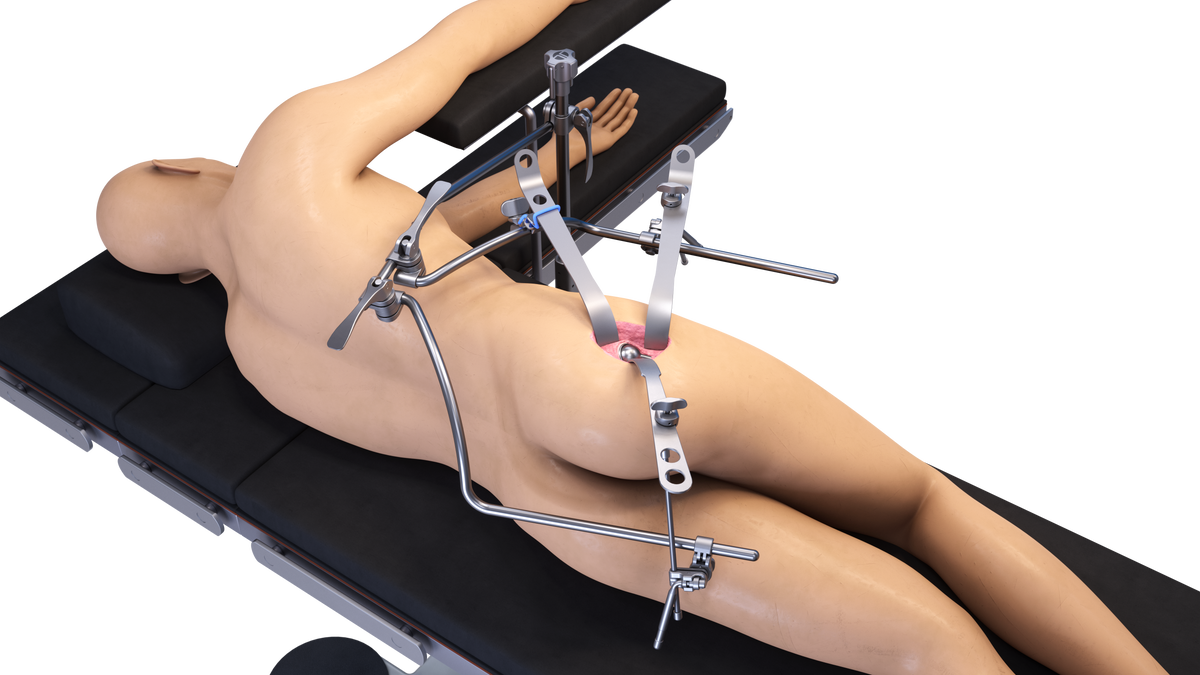
What Is Total Hip Arthroplasty?
Total hip arthroplasty replaces the damaged surfaces of the hip joint and may be performed through anterior, lateral, or posterior surgical approaches. The Thompson Hip Retractor Set can be configured to support each of these approaches, with frame position, blade selection, and retraction direction adjusted according to the surgeon’s technique and exposure requirements.
For the direct anterior approach, exposure progresses through the femoral neck and acetabulum before moving to proximal femoral elevation and canal preparation. Each phase requires sufficient working space for reaming, broaching, trialing, implant placement, and fluoroscopy when used.
Retraction Requirements for Hip Procedures
Hip exposure may need to support:
• Controlled access through the initial soft-tissue interval
• Stable femoral neck and acetabular exposure
• Independent positioning of several retractors around the hip
• Proximal femoral access during preparation
• Working space for instrumentation and imaging
• Compatibility with standard OR tables and leg-positioning equipment
How the Hip Retractor Set Supports Orthopedic Exposure
The Hip Retractor Set establishes the shared orthopedic frame around the operative field using an Elite Rail Clamp, crossbar, and curved arms. Tethers and clip-on blade adapters offer multiple attachment options, allowing the surgical team to secure individual retractors once the surgeon has established the desired position.
The Hip Blade Kit includes Cobra, Hohmann, dual-prong, and femoral neck elevator options for acetabular and femoral exposure. Curved blade options are available for deeper access. The lateral curved arm can be positioned low to preserve working space, and an optional upright arm can provide additional reach when required.
A rail extender provides an attachment point for the Thompson rail clamp when the Hip Retractor Set is used with a Hana® table or another leg-positioning system. Table compatibility and final setup should be confirmed before the procedure and carried out in accordance with the applicable user manual and instructions for use.
Knee Retractor Set
What Is Total Knee Arthroplasty?
Total knee arthroplasty replaces damaged articular surfaces of the distal femur and proximal tibia and may include patellar resurfacing. Exposure must remain controlled as the knee moves through flexion and extension and as the surgeon completes bone preparation, balancing, trialing, and implant placement.
Retraction Requirements for Knee Procedures
Knee procedures may require:
• Stable medial, lateral, and posterior retraction as required by the approach
• Access to the distal femur and proximal tibia
• Working space for conventional, navigated, or robotic instrumentation
• Adjustment as the knee position changes
• Blade placement matched to anatomy, deformity, stiffness, and surgeon preference
How the Shared Orthopedic Frame Supports Knee Exposure
The Knee Retractor Set uses the same core table-mounted frame as the Hip Retractor Set. The frame is repositioned for the knee application, creating stable attachment points around the joint for compatible surgeon-selected retractors.
Blades may be secured with the appropriate Thompson handles, clip-on blade adapters, or tethers. Individual retraction points can then be refined as the knee position and exposure requirements change without rebuilding the complete frame. This preserves workspace for the surgeon’s preferred instrumentation while reducing reliance on continuous manual holding.
Shoulder Retractor Set
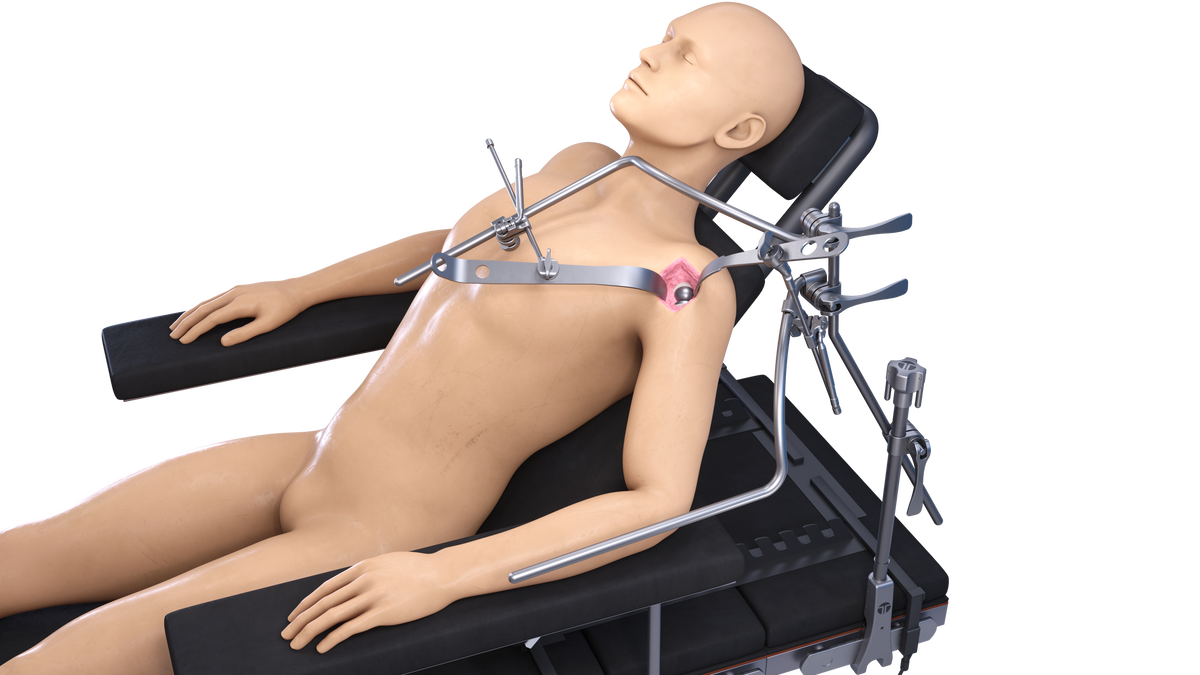
What Are Shoulder Arthroplasty Procedures?
Shoulder arthroplasty may involve anatomic or reverse reconstruction of the glenohumeral joint. Exposure progresses from the deltopectoral interval to the humerus and glenoid. Glenoid preparation requires direct access while preserving room for retractors, reamers, guides, trials, and implant instruments.
Retraction Requirements for Shoulder Procedures
Shoulder procedures may require:
• Stable exposure with the patient in the beach-chair position
• Controlled displacement of the humerus
• Direct access to the glenoid
• Independent adjustment around the deltopectoral field
• Clearance around the patient’s head, neck, and primary working paths
• Compatibility with the surgeon’s preferred shoulder retractors
How the Shared Hip Frame Supports Shoulder Exposure
The Shoulder Retractor Set uses the same core frame as the Hip Retractor Set in a shoulder-specific arrangement. The Elite Rail Clamp is positioned on the operative side, and the crossbar and curved arms contour around the shoulder to create attachment points above and below the field.
The surgeon’s preferred shoulder retractors can be secured to the frame with tethers or clip-on handles. Thompson does not manufacture the shoulder blades shown with this configuration, but rather allows the surgeon to use the handheld blades the hospital already has on site, so blade compatibility should be confirmed before clinical use. The shoulder setup should follow the applicable Thompson technique and instructions for use.
Femur Elevator Retractor Set
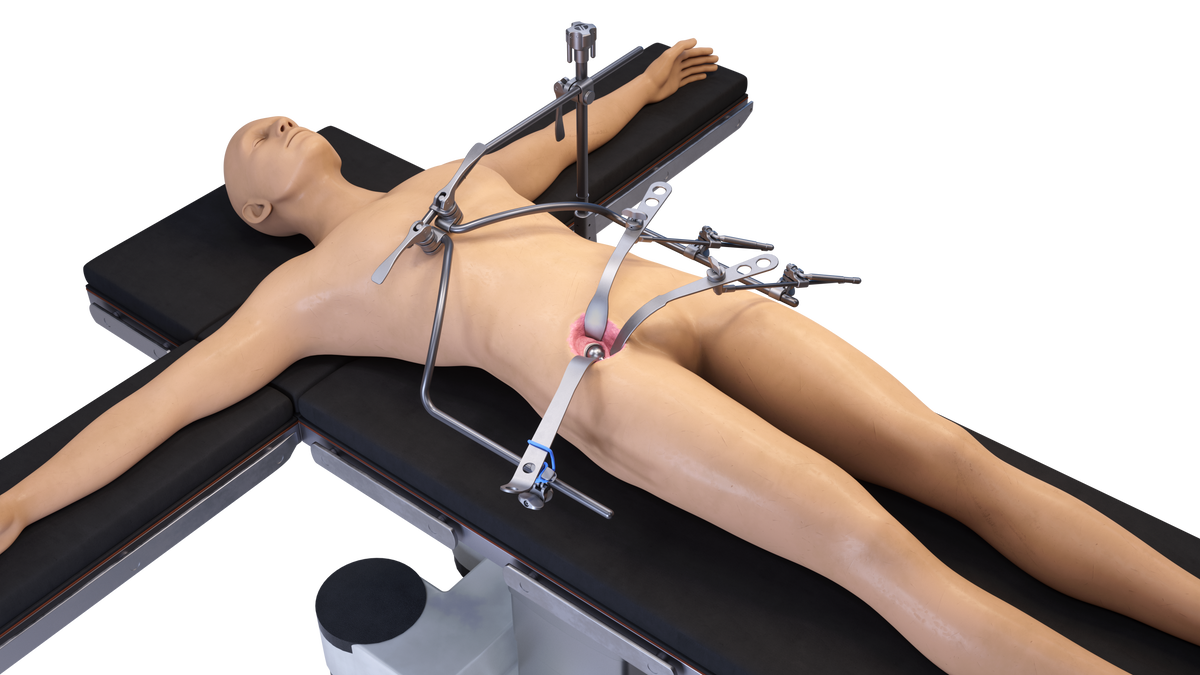
Why Femoral Elevation Matters During the Direct Anterior Approach
Proximal femoral exposure is a distinct phase of direct anterior hip arthroplasty. The femur must be elevated and positioned to provide access to the canal for broaching, trialing, and component insertion. The required elevation depends on patient anatomy, soft-tissue release, table position, and the surgeon’s technique.
Retraction Requirements for Femoral Preparation
Femoral preparation may require:
• Controlled elevation of the proximal femur
• Stable positioning during canal preparation
• Incremental adjustment of retraction
• A focused setup that preserves access around the femoral canal
• Compatibility with the Hip frame or use as an independent configuration
How the Femur Elevator Retractor Set Supports Exposure
The Femur Elevator Retractor Set attaches to the OR bedrail through an Elite Rail Clamp. A straight arm with an elevator handle supports the femur hook, creating a focused table-mounted configuration for femoral elevation.
The micro-adjustable handle allows the surgical team to refine retraction incrementally and release tension through the handle mechanism. The set may be used alone or with the Hip frame, allowing femoral elevation to be integrated into the broader direct anterior hip exposure strategy.
Comparing Thompson Orthopedic Retractor Set Configurations
The Hip, Knee, and Shoulder Retractor Sets share the same core frame. Their differences primarily lie in the frame orientation, attachment method, and blades used in the procedure.
| Configuration | Frame and Components | Exposure Application |
|---|---|---|
| Hip Retractor Set | Shared orthopedic frame with crossbar, curved arms, handles or tethers, and Thompson Hip Blade Kit | Femoral neck, acetabular, and proximal femoral exposure |
| Knee Retractor Set | Same shared orthopedic frame arranged for the knee with compatible surgeon-selected retractors | Stable, adjustable exposure around the knee joint |
| Shoulder Retractor Set | Same shared orthopedic frame arranged around the shoulder with compatible blades, tethers, or clip-on handles | Humeral and glenoid exposure in the beach-chair position |
| Femur Elevator Retractor Set | Separate straight-arm configuration with elevator handle and femur hook | Controlled femoral elevation during direct anterior hip procedures |
Frame selection is one part of the decision. Blade style, attachment method, patient position, table configuration, exposure depth, imaging requirements, and surgeon preference also influence the final orthopedic retraction setup.
Optimizing Retraction for Orthopedic Procedures
Orthopedic retractor setup begins with the procedure, patient position, and planned working paths. The frame must support the intended direction of retraction while remaining clear of the surgeon, anesthesia team, imaging equipment, navigation arrays, robotic components, and other table-mounted accessories.
Important setup factors include:
• Confirming compatibility with the OR table or positioning equipment
• Positioning the rail clamp and frame before applying retraction
• Keeping frame components clear of the patient and operative workspace
• Selecting blades and attachment methods based on the joint, approach, and anatomy
• Applying retraction incrementally and refining one point at a time
• Maintaining access for imaging, navigation, robotics, and implant instrumentation
• Following the applicable user manual and instructions for use
• Standardizing tray organization, setup sequence, and reprocessing with OR and SPD teams
A repeatable setup helps the OR team identify the correct frame components, handles, attachments, and blades before the case. It also gives SPD staff a consistent basis for tray organization, inspection, and case readiness.
Choosing the Right Retractor Set for Orthopedic Surgery
Orthopedic retractor selection should begin with the joint, surgical approach, and required exposure. Hip procedures may combine multi-point acetabular retraction with controlled femur elevation, while knee and shoulder procedures require frame positioning suited to the operative position and working space.
Surgeons, OR leaders, and value-analysis teams should consider:
- Procedure, approach, and primary or revision application
- OR table and positioning-equipment compatibility
- Required retraction directions and blade or handle compatibility
- Clearance for imaging, navigation, robotics, and instrumentation
- OR setup repeatability, tray organization, and SPD workflow
The appropriate orthopedic retractor set should maintain the required exposure while preserving working space and fitting the facility’s equipment, instruments, and clinical workflow.
Why Table-Mounted Retraction Matters in Orthopedic Procedures
Orthopedic procedures often require several retraction points to remain stable while the surgeon changes joint position, instruments, or exposure phase. A table-mounted frame provides an external foundation that can hold those points independently without relying on continuous manual force.
Table-mounted orthopedic retraction can support:
• Stable, hands-free retraction
• Controlled placement of multiple retractors
• Reduced reliance on continuous manual holding
• Incremental adjustment during the procedure
• Configurable use across hip, knee, and shoulder applications
• Repeatable setup for trained surgical teams
The shared hip retractor frame architecture can also support standardization across orthopedic procedures. Teams can become familiar with the same rail clamp, crossbar, curved arms, and attachment methods while adapting the final setup to each joint.
Clinical Evaluation & Quotes
A clinical evaluation allows surgeons and OR teams to assess an orthopedic retractor set during representative hip, knee, or shoulder procedures before making a long-term decision.
Thompson offers a 30-day clinical evaluation for U.S. customers. Thompson coordinates the appropriate configuration, trains OR and SPD teams, and provides support throughout the evaluation.
During the evaluation, the team can assess table compatibility, frame positioning, blade and handle selection, femur elevation requirements, working space, setup repeatability, staff familiarity, tray organization, and reprocessing workflow.
Frequently Asked Questions
Do the Hip, Knee, and Shoulder Retractor Sets use the same frame?
Yes. Thompson documents the same core table-mounted frame for hip, knee, and shoulder applications. The frame is repositioned around the operative field and paired with the blades and attachment method required for each procedure.
What is the difference between the Hip, Knee, and Shoulder Retractor Sets?
The primary differences are the procedure-specific frame arrangement and blade selection. The Hip Retractor Set includes Thompson hip blade options. The Knee and Shoulder Retractor Sets use the shared frame with compatible surgeon-selected retractors.
What is a femur elevator retractor used for?
A femur elevator retractor provides controlled elevation of the proximal femur during the femoral-preparation phase of direct anterior hip arthroplasty. The Thompson Femur Elevator Retractor Set uses a separate rail-mounted straight arm, elevator handle, and femur hook and may be used alone or with the Hip frame.
Can the Hip Retractor Set be used with a Hana® table?
Yes. Thompson provides a rail extender for use with a Hana® table and other leg-positioning systems. The rail extender creates an attachment point for the Thompson rail clamp, and setup should follow the Hip Retractor User Manual.
Does Thompson manufacture the blades used with the Shoulder Retractor Set?
Thompson does not manufacture the shoulder blades shown with the Shoulder Retractor Set. The shared frame accommodates surgeon-selected shoulder retractors with tethers or clip-on handles, and compatibility should be confirmed before use.
Thompson Table-Mounted Orthopedic Retractor Sets
Thompson’s orthopedic offering is built around a shared table-mounted frame that supports hip, knee, and shoulder applications. The Hip Retractor Set pairs that frame with procedure-specific hip blades, while the Knee and Shoulder Retractor Sets adapt the same frame to compatible surgeon-selected retractors. The Femur Elevator Retractor Set provides focused support during proximal femoral preparation and can be used alone or with the Hip frame.
For more than 60 years, Thompson Retractor Instruments has focused on advancing table-mounted retraction for stable, hands-free surgical exposure. Our employee-owned team supports orthopedic surgeons, OR staff, and SPD teams with configurable frames, training, and clinical evaluation support. Contact us to learn more about selecting table-mounted retractor sets for orthopedic procedures.