


Breast Procedures
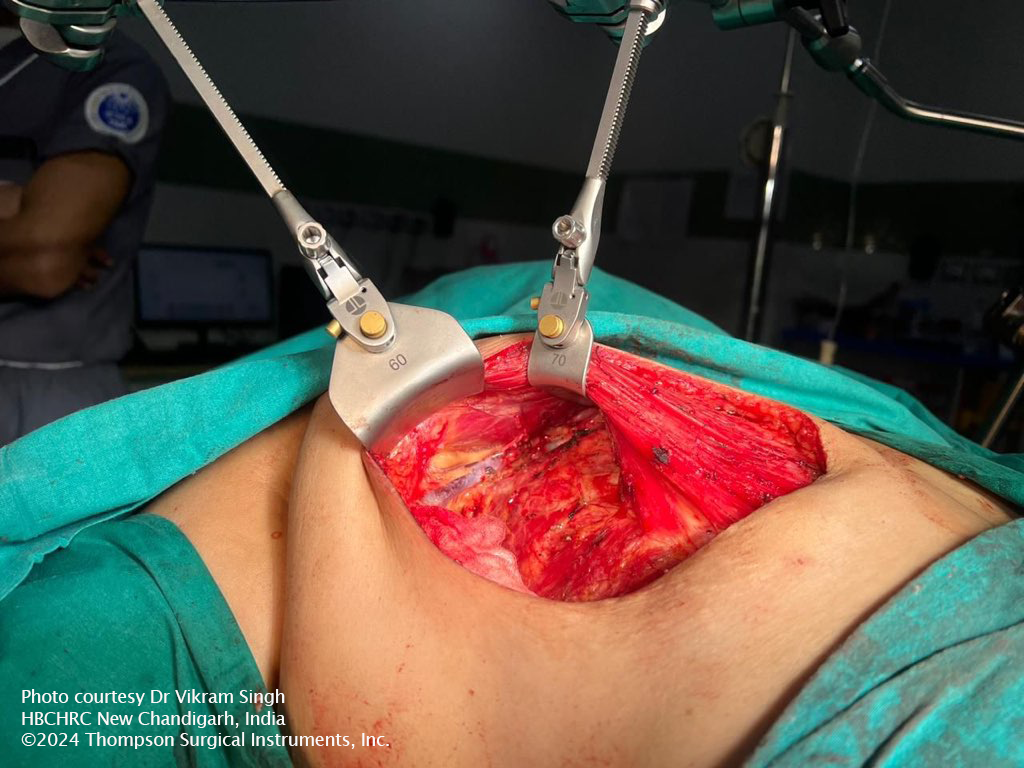
Table-Mounted Retractor Sets for Breast Procedures
Table-mounted breast retractor sets provide stable, hands-free exposure during mastectomy and related open breast surgery. Thompson offers Articulating Arm and C-Frame configurations that allow surgical teams to position breast-specific blades according to the incision, anatomy, operative target, and preferred retraction strategy.
Why Breast Procedures Require Controlled, Adaptable Retraction
Mastectomy exposure may need to extend well beyond the immediate incision. As dissection progresses, the surgical team may need access to the superior, medial, lateral, and inframammary regions of the breast, as well as the axillary tail when required.
The exposure challenge can become more pronounced when a skin-sparing or nipple-sparing approach uses a limited or strategically placed incision. Blade position, retraction direction, and working space must support access across the breast envelope while remaining adjustable as the operative target changes.
Important retraction requirements may include:
- Stable hands-free exposure
- Controlled skin and soft-tissue retraction
- Access beyond a limited incision
- Independent positioning of individual blades
- Exposure that can move with the dissection
- Working space for visualization and instrumentation
- Access for reconstructive steps when applicable
- Blade options matched to tissue type and exposure depth
For breast surgeons and OR teams, retractor selection is closely tied to incision strategy, breast anatomy, procedure type, and whether the exposure must remain fixed or change frequently during the operation.

What are Table-Mounted Breast Retractor Sets?
Table-mounted breast retractor sets attach directly to the operating room bed rail. The rail-mounted foundation supports the frame or articulating arms used to position blades around the incision.
Once exposure is established, the retractor holds the blades in position without relying solely on continuous manual retraction. Individual blades can be adjusted as the surgeon moves to another area of the breast.
Thompson’s breast configurations provide two different approaches:
- Articulating arms for flexible, independently controlled blade positioning
- A rigid C-Frame for stable frame-based retraction around the operative field
Both configurations use breast-specific blade options for skin, soft-tissue, and muscle retraction.
Mastectomy Procedures and Exposure Requirements
What Is a Mastectomy?
A mastectomy is the surgical removal of breast tissue for cancer treatment or risk reduction. The operation may be performed as a simple, skin-sparing, or nipple-sparing procedure, depending on the clinical plan and reconstructive approach.
Incision location and length can vary significantly. In a traditional simple mastectomy, the incision may provide broader direct access. Skin-sparing and nipple-sparing procedures may use more limited incisions while requiring access across a wide tissue plane beneath the preserved breast skin.
Retraction must support the chosen approach while preserving workspace for the breast surgeon and, when reconstruction is planned, the reconstructive team.
Retraction Requirements for Mastectomy Procedures
Effective retraction during mastectomy may need to support:
- Exposure across the breast envelope
- Controlled elevation of skin and soft tissue
- Access to superior, medial, lateral, and inferior tissue planes
- Stable blade positioning during dissection
- Adjustments as the operative target changes
- Access to the axillary tail when required
- Working space around limited incisions
- Coordination between the breast and reconstructive teams
- Blade selection matched to the tissue and depth of exposure
Thompson offers Mastectomy Articulating Arm and C-Frame breast retractor set configurations for these exposure needs.
Mastectomy Articulating Arm Retractor Set
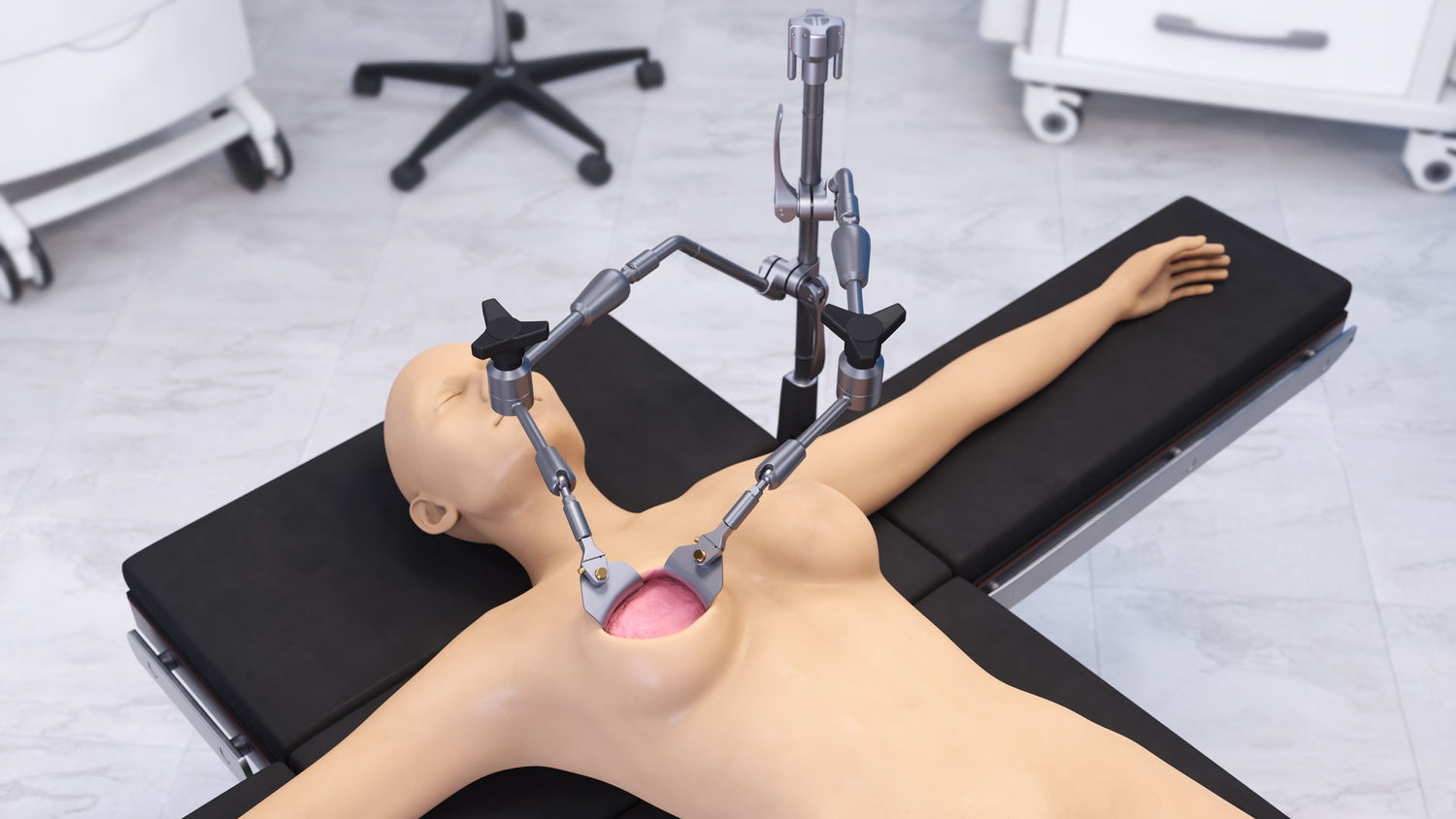
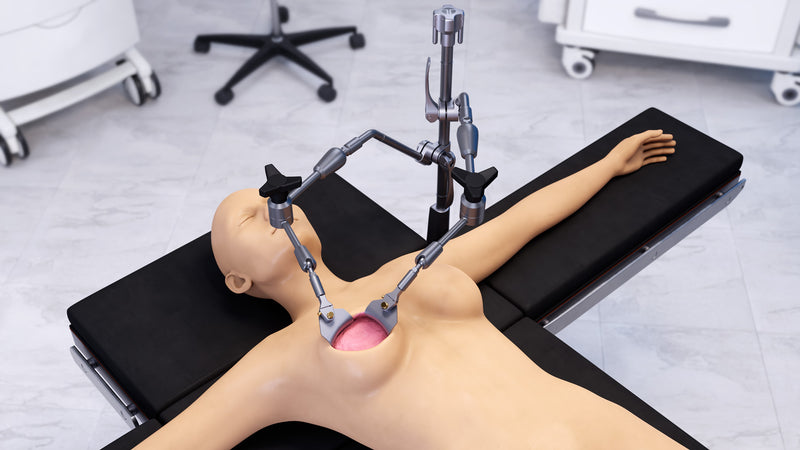
The Mastectomy Articulating Arm Retractor Set provides flexible, hands-free retraction through independently positioned articulating arms.
The configuration includes two small S-Lock Articulating Arms. Each arm attaches to the table-mounted rail clamp or an optional crossbar and holds a blade around the incision. The arms can be positioned independently, allowing the surgical team to establish separate retraction points and refine them as dissection progresses.
This dynamic configuration is particularly relevant when exposure must shift around the breast. One arm can be repositioned without disrupting the blade held by the other arm, helping the team maintain established exposure while adjusting access to another tissue plane.
Paired with the Breast Blade Kit, the articulating arms can support controlled retraction across different areas of the breast through a focused setup that functions as an additional set of hands.
Optional Crossbar Configuration
An optional 24-inch crossbar with two Cam III joints can provide additional mounting and positioning options. The crossbar attaches to the rail clamp and can support the articulating arms or retractor handles around the incision.
This alternative setup allows the team to organize retraction points by patient, incision, and planned operative access.
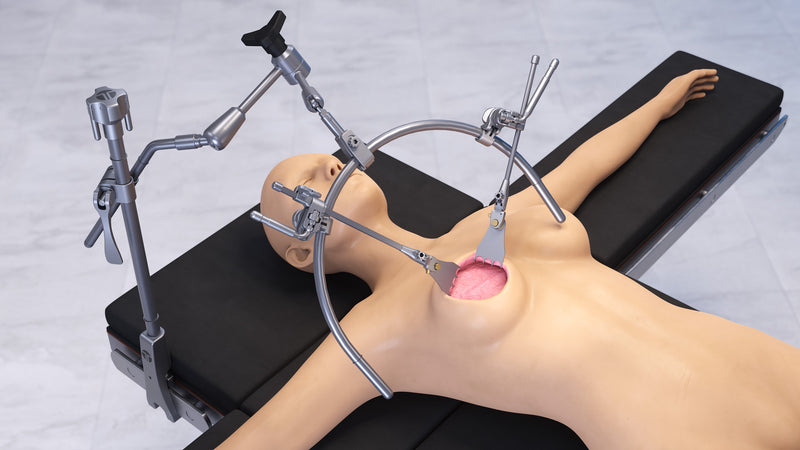
Mastectomy Breast C-Frame Retractor Set
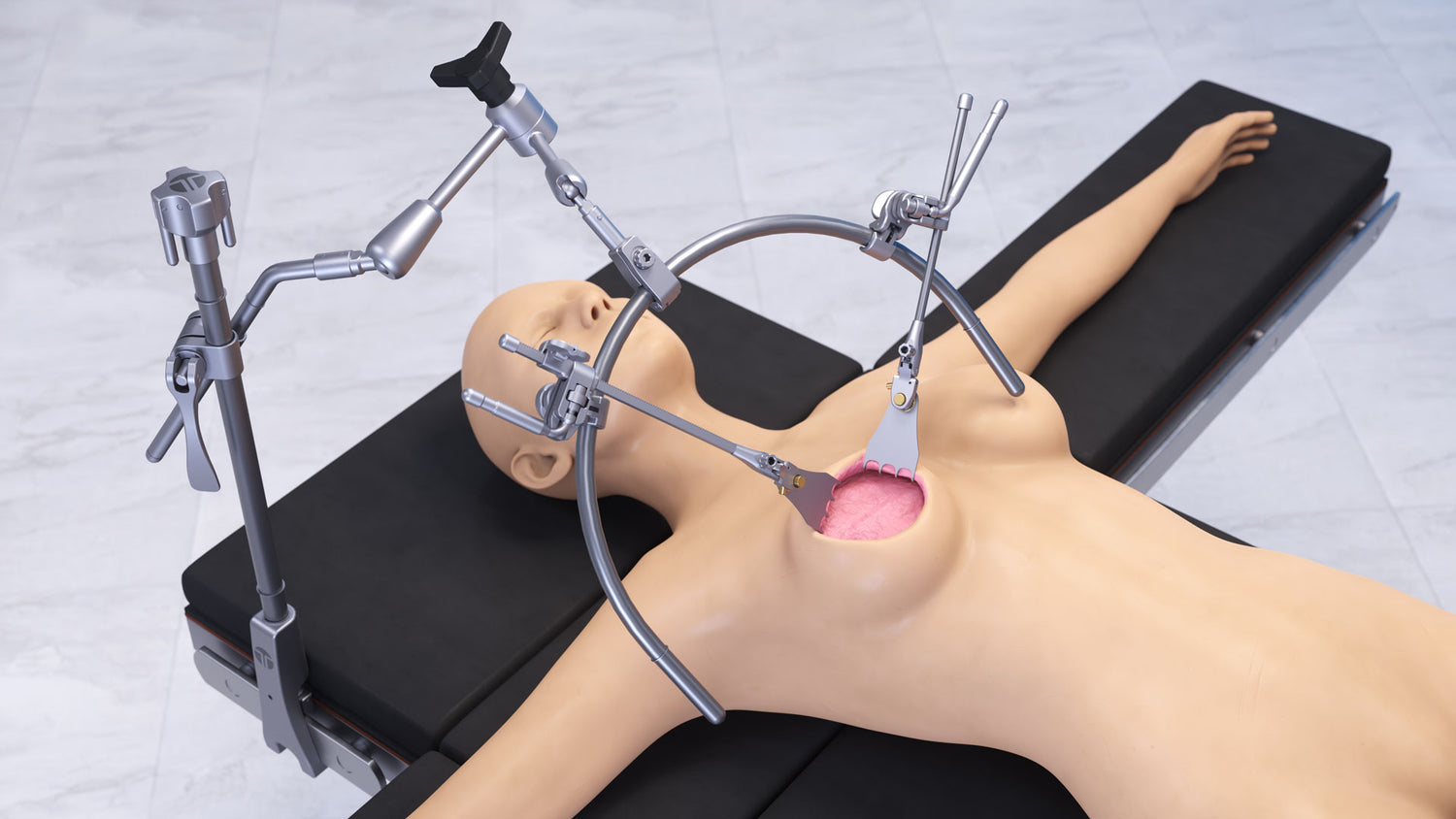
The Mastectomy Breast C-Frame Retractor Set combines a specialized Breast Blade Kit with the rigid stability of a table-mounted C-Frame.
The 13½-inch C-Frame is supported by an extension arm with a fixed hinge joint. Once positioned, the frame provides a stable foundation around the operative field with multiple options for blade placement.
The C-Frame configuration may be appropriate when the surgeon prefers a defined frame around the incision and stable retraction points throughout the procedure. It can support broad exposure while keeping the central working area available for dissection and instrumentation.
Quick Angle and Micro-Adjustable Handles
The C-Frame configuration includes a Cam II Clip-On Quick Angle Handle and a Mini Micro-Adjustable II Clip-On Quick Angle Handle.
These handles attach retractor blades to the frame and allow the blade angle to be adjusted up or down by up to 45 degrees. This gives the surgical team control over the direction of retraction while keeping the blade secured to the frame.
The micro-adjustable handle also supports finer control when the team needs to refine a specific retraction point without repositioning the full frame.
Breast Blade Options for Mastectomy Exposure
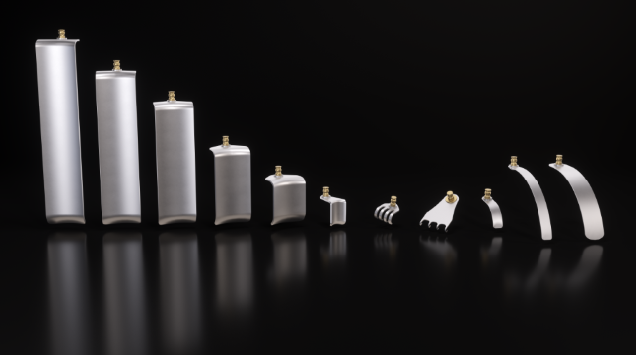
Blade selection is an important part of the breast retraction strategy. Different areas of the procedure may require focused skin retraction, broader soft-tissue control, shallow muscle retraction, or access through a deeper or more limited incision.
Breast Blade and Illumination Options
The Thompson breast retractor set includes blade options for different tissue and exposure requirements.
Richardson Blades
The breast blade set includes a smaller Richardson blade for muscle retraction through small or mini incisions. Radio Richardson blades are available in several lengths for breast incision or abdominal wall retraction.
Cat’s Paw Blades
Cat’s Paw blades provide focused skin retraction around the operative field.
Murphy Sharp Four-Prong Blade
The Murphy Sharp Four-Prong blade is intended for skin and shallow-muscle retraction.
Malleable Blades
Malleable blades are available in several sizes for soft-tissue retraction.
Blade selection depends on the procedure, incision, anatomy, exposure depth, and surgeon preference.
Lite Wand
The Thompson Breast Retractor Set also includes a Lite Wand for illuminating the incision area. This provides an integrated illumination option when additional light is required within the operative field.
Comparing Breast Retractor Configurations
Configuration
Articulating Arm
C-Frame
Primary Characteristics
Two independently positioned arms with S-Lock blade control
Rigid frame with Quick Angle and micro-adjustable handles
Exposure Application
Flexible exposure that changes as dissection progresses
Stable frame-based exposure with controlled blade positioning and angulation
Both configurations use breast-specific blade options. The primary difference is how the retraction points are supported and adjusted.
The Articulating Arm configuration provides independent, mobile control points. The C-Frame provides a defined, rigid structure around the operative field. The appropriate choice depends on the incision, planned dissection, surgeon preference, and desired setup.
Optimizing Retraction for Breast Procedures
Effective breast retraction begins with the incision and the tissue planes that must be accessed. The rail clamp, frame, arms, and blades should be positioned so they support the planned direction of retraction while preserving the surgeon’s working space.
Important setup considerations include:
- Selecting the frame or arm configuration before the procedure
- Positioning the rail clamp to support the planned operative field
- Matching blade style and length to the tissue and exposure depth
- Applying retraction incrementally
- Keeping arms and handles outside primary instrument paths
- Repositioning individual blades as dissection progresses
- Preserving working space for reconstruction when applicable
- Using additional illumination when needed
- Confirming that the setup remains stable throughout the procedure
For limited-incision procedures, the team may place greater emphasis on precise blade placement and the ability to redirect exposure. For procedures requiring broader access, a stable C-Frame arrangement may provide the preferred structure around the field.
Clinical Evaluation and Quotes
A clinical evaluation allows surgeons and OR teams to compare the Articulating Arm and C-Frame configurations during representative breast procedures.
Thompson offers a 30-day clinical evaluation for U.S. customers. The evaluation includes OR and SPD training, case support, and an opportunity to assess blade selection, positioning, working space, setup repeatability, and reprocessing workflow.
During the evaluation, the surgical team can determine which configuration best supports its mastectomy procedures, incision strategies, and reconstructive workflows.
Available for U.S. customers only.
Select the procedure that best fits your clinical needs.
Thompson Surgical Instruments engineers table-mounted retractor sets designed to provide stable, hands-free retraction in complex open procedures.
We support surgical teams with modular configurations, training, and clinical evaluations.
Contact us today to learn more about our table-mounted retractor sets for liver procedures.